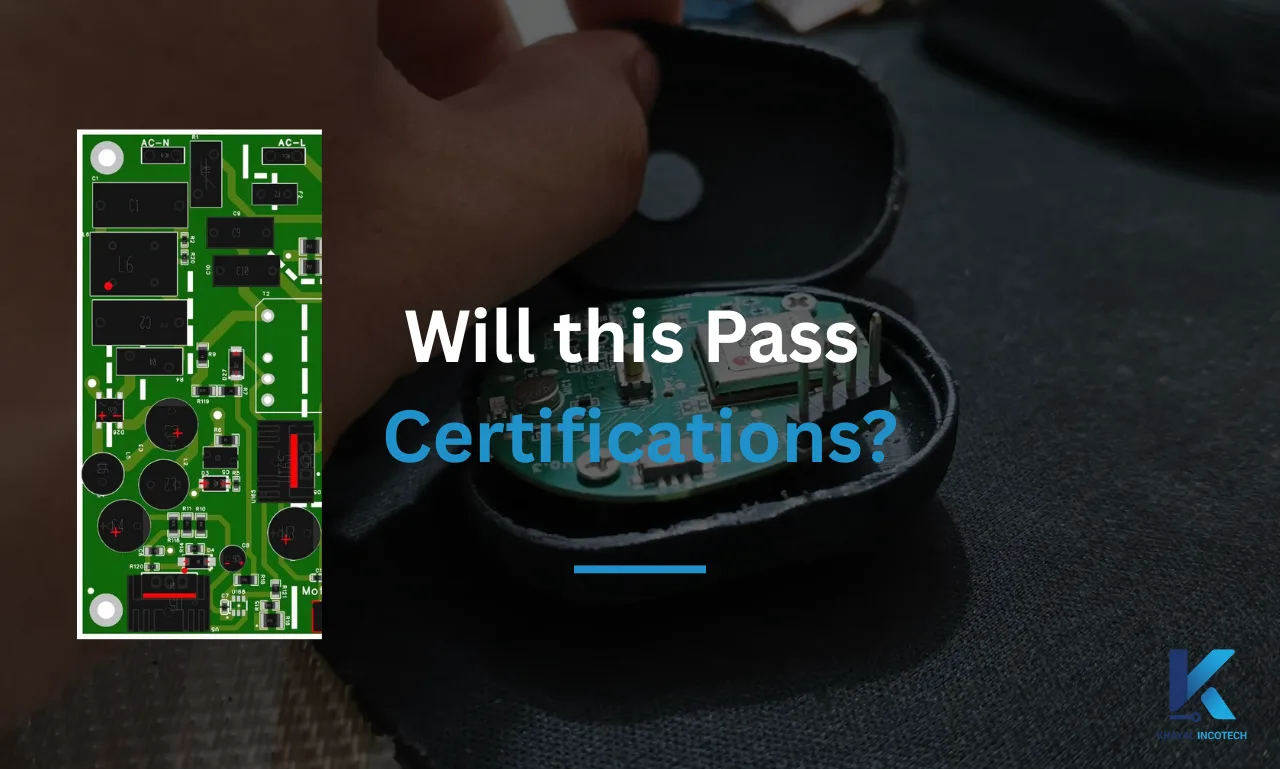
Every founder building a physical product asks this eventually, usually about two months later than they should have. The answers online are useless, because they are written by test labs whose business model depends on you calling them for a quote.
So here are real numbers from two of our own products.
A battery powered consumer device with a wireless module cost $3,000 and took a month. FCC, CE and EMC. We sent the lab one fully built unit and got a report back.
A mains powered countertop appliance with a heater and motors cost substantially more and took the same month. ETL and the rest.
Different company, Different year, same lab turnaround. Wildly different invoices. The reason that gap exists is the most useful thing in this article.
EMC and safety are two different things
Most people budgeting for certification are thinking about EMC. Does my product emit radio noise, and does it survive being emitted at.
That is one workstream. Safety certification is another, and it is the expensive one.
A battery powered device that never touches mains has no conducted emissions path into the wall, so a large part of the EMC test plan simply does not apply. Radiated emissions, the radio if you have one, and you are largely done.
Put a heater coil and a motor on the mains and everything changes. Now you have conducted emissions on the supply. You have temperature rise testing. Abnormal operation testing, which means deliberately faulting the thing and confirming it does not set fire to a kitchen. Dielectric strength, leakage current, and a construction review where the lab checks that every safety critical component in your bill of materials is itself a recognised part.
That last one catches people. You cannot buy a cheap thermal cutout off a marketplace and expect it to pass. The component needs its own approval, and if it does not have one you are respinning the design after the report comes back.
So when someone says certification cost them three thousand dollars, ask what was in their product before you budget from it.
The distinction nobody explains
There are two routes through FCC and people mix them up constantly.
Certification applies to intentional radiators, anything that deliberately transmits. It goes through a Telecommunication Certification Body, you get a grant, and you get an FCC ID that appears on the product.
Supplier's Declaration of Conformity, or SDoC, applies to unintentional radiators. Your microcontroller, your switching converter, your motor driver. Since the rules changed in 2017 you do not submit anything to anyone. You test, you assemble the evidence, and you declare conformity yourself.
The practical consequences are large. An SDoC product has no FCC ID, so putting one on the label is wrong. There is no grant, so there is no formal process for modifying it later. If you change something, you assess whether it affects emissions, you retest to whatever extent that assessment demands, and you update your own file.
We had a client who was certain his device needed an FCC ID. It did not. He would have spent money and weeks discovering that.
A pre-certified module does not certify your board
This is the most expensive misunderstanding in the category.
You buy a module with an FCC ID already on it. The radio is covered. Excellent.
Your buck converter is not. Your microcontroller is not. Your charging circuit is not. None of them inherit anything from that module's grant, and on a battery powered product those are exactly the things that fail.
Worse, the modular grant comes with conditions attached. Antenna type and gain, keep out areas, host layout requirements. Deviate from them and the modular approval no longer covers you, and you are suddenly certifying a whole intentional radiator rather than declaring conformity on a host.
Read the grant conditions before you lay the board out, not after.
What actually fails
Not the radio. Almost never the radio, because the radio was designed by people who do this for a living and it arrived pre certified.
What fails is the boring half of your board.
Switching converters, where the harmonics of the switching node radiate through whatever copper is nearby. Cables, particularly USB cables during charging, which become antennas the moment you plug them in. Brushed motors, where the commutator arcs and produces broadband noise, and the motor leads carry it out of the enclosure.
Ground return paths, plane splits, and stubs. Which is the same physics as signal integrity, approached from the other side.
Certification is designed in, not bolted on
The single most expensive mistake is treating certification as a step at the end.
By the time you have a fabricated board, the decisions that determine whether it passes are already made. Where the switching node sits. Whether the ground plane is whole. How the cable enters the enclosure. Where the motor leads run.
A failed chamber visit costs you the test fee again, plus a board respin, plus the lead time on both. On the battery product above, a second visit would have been most of another three thousand dollars and six weeks.
Which is why we pre scan on our own bench before anything goes to a lab. It does not replace the chamber, and it is not accredited. What it does is tell you which of your harmonics is sitting close to a limit line while it is still cheap to move it.
What to budget
If you are building a battery powered device with a pre certified radio module and no mains connection, three to five thousand dollars and a month is a reasonable planning assumption, provided nothing fails.
If your product plugs into a wall, and especially if it heats or moves anything, budget several times that and expect the safety workstream to be the larger half.
And in both cases, budget the possibility of failing once. Most products that fail, fail on something that could have been caught for nothing three months earlier.