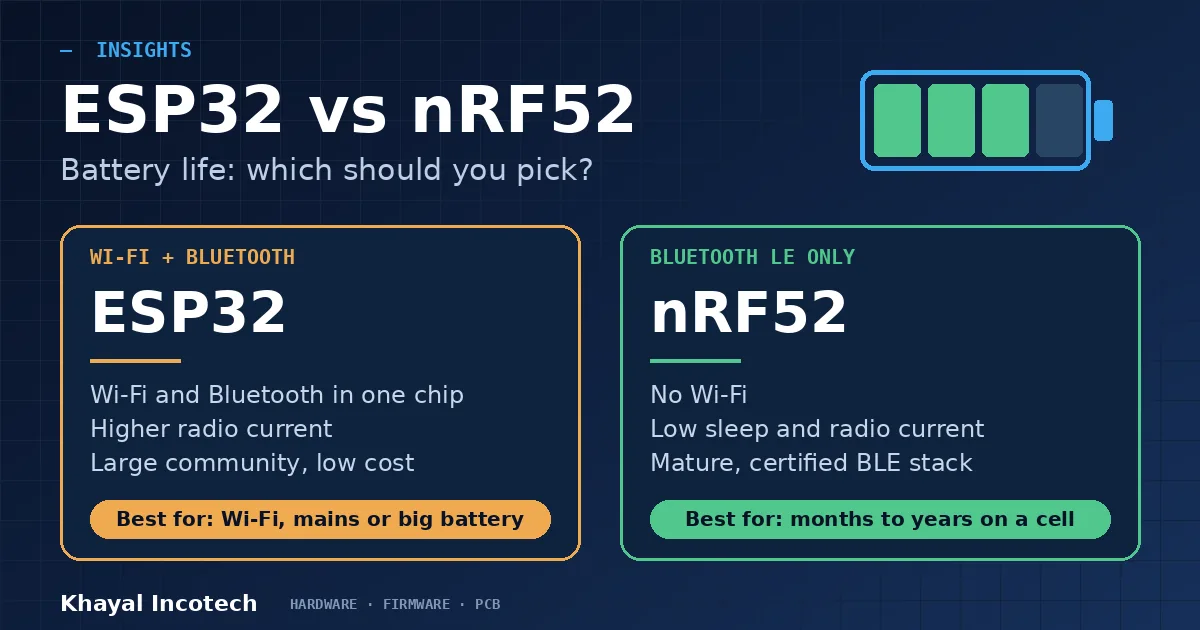
ESP32 vs nRF52 battery life is one of the first questions founders ask when a wireless product has to run for months or years on a small battery. The chip matters, but how you use the radio matters more. Here is how to think about it before you commit to a platform.
The short answer
If your product only needs Bluetooth Low Energy and has to run for months or years on a small battery, an nRF52 is usually the better starting point. If it needs Wi-Fi, or runs from the wall or a large battery, an ESP32 is usually the better choice.
Most of the difference comes from three things: how much current each chip draws while sleeping, how much it draws while the radio is on, and how long it takes to wake up.
Where the battery actually goes
A battery-powered wireless device spends almost all of its life asleep. Its average current is a blend of the sleep current, the current while the radio is active, and how often and how long it wakes.
A tiny sleep current paired with long, frequent wake-ups can drain a battery faster than a larger sleep current that wakes rarely. That is why comparing sleep current alone, the number on the first page of most datasheets, can mislead you.
ESP32 vs nRF52: the differences that matter
Radio current. A Bluetooth transmission on an nRF52 typically draws a few milliamps. On an ESP32 it typically draws tens of milliamps, and Wi-Fi draws more, with short peaks well above that. Over a long battery life, that gap adds up.
Sleep current. Both families have deep sleep modes. The nRF52 can keep a timer running at a few microamps or less. ESP32 deep sleep is typically in the range of several to a few tens of microamps, depending on the exact chip and what stays powered. Check the datasheet for your specific part, because the figures differ between the ESP32, ESP32-S3 and ESP32-C6, and between the nRF52832 and nRF52840.
Wake-up. An ESP32 coming out of deep sleep restarts the processor and usually has to set up the radio again, which takes longer and costs more energy each time.
What you give up. The nRF52 has no Wi-Fi. If your product must connect directly to a router, you need an ESP32 or another Wi-Fi chip.
A worked example
These are round numbers for illustration, not datasheet values. Say a sensor wakes once a minute, sends a reading and sleeps again, running from a CR2032 coin cell of roughly 220 mAh.
An nRF52-class chip sleeping at 3 µA, with a 10 ms burst at 8 mA, averages about 4 µA. On paper that is several years.
An ESP32-class chip sleeping at 10 µA, with a 10 ms burst at 100 mA, averages about 27 µA. On paper that is just under a year, and the longer restart time makes it worse.
Real life is harsher than the arithmetic. Coin cells lose capacity in the cold, cannot always supply radio peaks, and self-discharge over time. Use numbers like these to compare options, not to promise a battery life.
Which one to pick
Choose an nRF52 when the product only needs Bluetooth, when battery life is measured in months or years, or when you need Bluetooth mesh or a mature, certified Bluetooth stack.
Choose an ESP32 when the product needs Wi-Fi, when it runs from mains or a large battery, or when you want a low-cost, flexible chip with a large developer community.
If you need both Wi-Fi and a long battery life, a common approach is to keep the Wi-Fi radio off until it is needed, using Bluetooth for everyday traffic and Wi-Fi only for rare, large transfers.
Things that matter more than the chip
The voltage regulator. A regulator that draws a few microamps on its own can cost more battery life than the chip’s sleep current. Check its quiescent current. Switching regulators also bring layout problems of their own, which we cover in our guide to buck converter EMC.
The rest of the board. A sensor that never turns off, a leaky pull-up resistor or a status LED left on can each outweigh the microcontroller.
The firmware. Wake as rarely as you can, send as little as you can, and never keep the radio on waiting for a reply. In Bluetooth firmware, advertising and connection intervals are the biggest levers you have.
Estimate battery life before you build
A battery life estimate takes an hour on paper and can save a board respin. If you are choosing a chip for a battery-powered product, talk to us about firmware development before you commit to a platform. On our own work, such as a BLE Mesh sensor node that shipped with a 24-month life on a single coin cell, we design around the battery life target from day one.
Not sure which chip fits? Tell us what it does and we will tell you which platform we would pick.