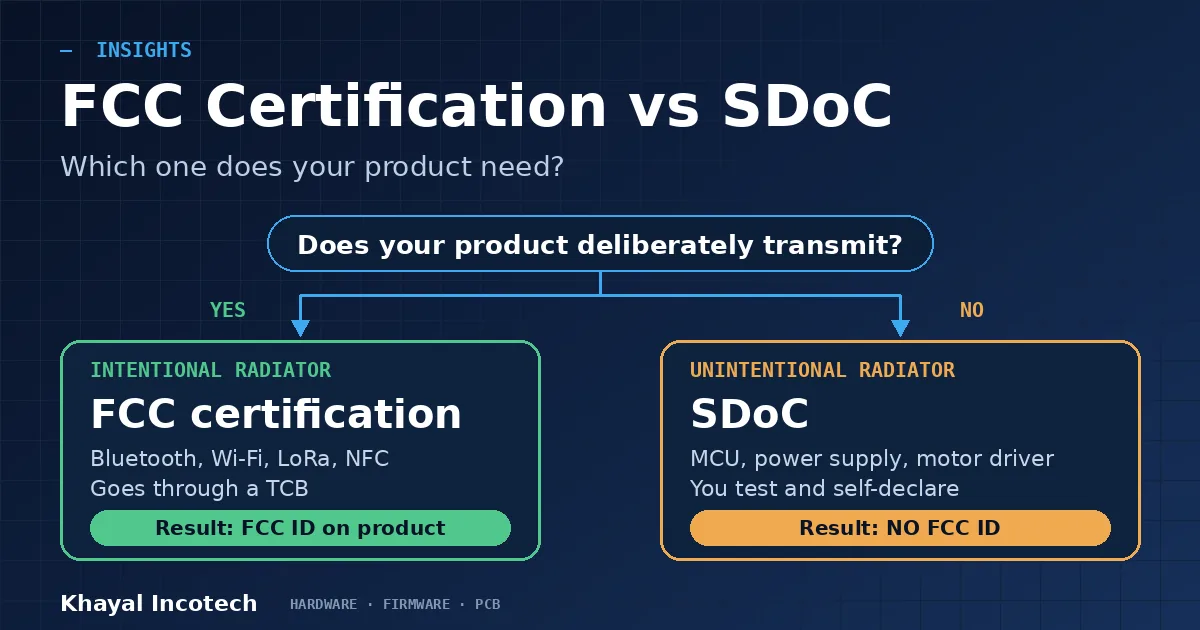
FCC certification vs SDoC is one of the most confusing questions for hardware founders, and getting it wrong can cost you weeks and money. Not every electronic product needs an FCC ID, and knowing which route applies to yours is the first step.
For real budget numbers, see our breakdown of what hardware certification actually costs.
This guide covers FCC rules, which apply to products sold in the United States. Selling in Europe? That market uses CE marking instead, covered separately.
What is FCC certification?
FCC certification applies to intentional radiators, which are products that deliberately transmit radio signals. Bluetooth, Wi-Fi, LoRa, cellular and NFC devices all fall into this group.
The process runs through a Telecommunication Certification Body (TCB). You submit your test reports, the TCB reviews them, and if everything passes you receive a grant of equipment authorization and an FCC ID. That ID then has to be shown on the product or its electronic label.
What is SDoC?
Supplier's Declaration of Conformity (SDoC) applies to unintentional radiators. These are electronics that generate radio-frequency noise as a by-product without meaning to transmit. Microcontrollers, switching power supplies, motor drivers and charging circuits are typical examples.
Since the FCC changed its rules in 2017, you don't submit anything to anyone. You test the product, keep the evidence on file, and declare conformity yourself. Two consequences follow. There is no grant, so there is no FCC ID, and putting one on an SDoC product's label is wrong. You also need to name a responsible party in the United States who stands behind the declaration.
Which one does your product need?
Start with one question: does your product deliberately transmit?
If yes, the radio needs FCC certification. Using a pre-certified module makes this far simpler, because the module already carries its own grant. If no, your product most likely falls under SDoC. A few unintentional radiators, such as scanning receivers and TV interface devices, still require certification, so confirm your product's category before you assume.
Many products need both. A Bluetooth wearable, for example, has a certified radio and also digital circuitry that must comply as an unintentional radiator.
One of our clients was certain his device needed an FCC ID. It didn't, and he came close to spending weeks and money on a process he never needed.
The mistake that catches teams with pre-certified modules
A module with an FCC ID covers the radio and nothing else. Your buck converter, microcontroller and charging circuit inherit nothing from the module's grant, and on battery-powered products those are exactly the parts that tend to fail.
The grant also comes with conditions: approved antenna types and gain, keep-out areas, and host layout requirements. If your design deviates from them, the modular approval no longer covers you, and you may end up certifying an entire radio instead of simply declaring conformity. Read the grant conditions before you lay out the board, not after.
What happens when you change your design later
For an SDoC product there is no grant, so there is no formal modification process. If you change a component, a layout or a cable, you assess whether the change could affect emissions, retest as far as that assessment requires, and update your own compliance file.
A certified radio is different. Changes to the radio or its antenna setup may require a filing with the TCB, so check before you change anything.
Get it right before the lab
Certification is designed in, not bolted on. By the time a board is fabricated, most of the decisions that decide a pass or fail have already been made: where the switching node sits, whether the ground plane is whole, and how cables enter the enclosure.
That's why we pre-scan on our own bench before anything goes to a lab. It doesn't replace the chamber, but it shows which emissions are close to the limit while they're still cheap to fix. Learn more about how we handle this in our production and certification service.
Not sure which route your product falls under? Talk to us and we'll tell you before you spend anything on testing.