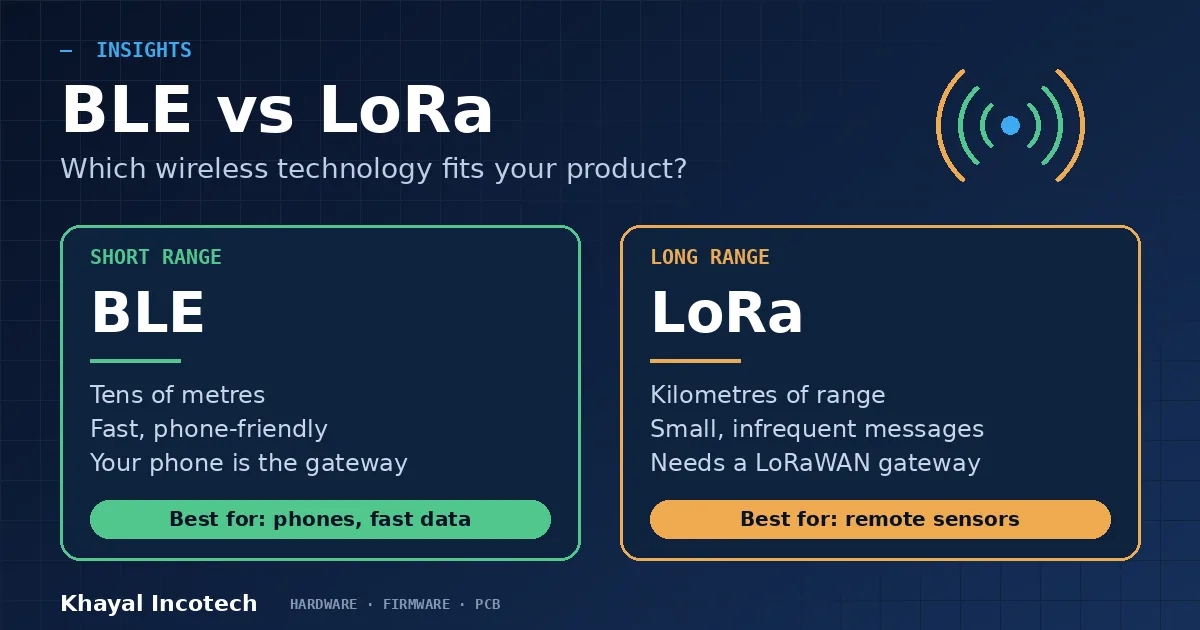
BLE vs LoRa is a choice many founders face when a product has to send data wirelessly. Both are low-power, both are used in battery-powered devices, and they are built for very different jobs. Pick the wrong one and you may have to redesign the board, the firmware and the certification plan.
The short answer
Choose BLE when your device talks to a phone or sits within tens of metres of what it talks to. Choose LoRa when it has to send small amounts of data over hundreds of metres or kilometres, from places with no Wi-Fi or mobile signal.
Most of the difference comes down to range, data rate, infrastructure and regional rules.
What BLE and LoRa actually are
BLE stands for Bluetooth Low Energy, the low-power part of Bluetooth. It works in the 2.4 GHz band, every modern phone supports it, and it moves data quickly over short distances.
LoRa is a radio technique built for long range at low power. It works in lower-frequency bands, and it is usually paired with LoRaWAN, the network protocol that connects devices through gateways to the internet.
Range
BLE typically reaches tens of metres, and up to around 100 metres in open space. The newer long-range modes in Bluetooth 5 can stretch this, at the cost of speed.
LoRa is a different scale. Sources commonly quote a few kilometres in a town and up to around 15 to 20 kilometres in open country. Walls, hills and antennas change this a lot, so treat these numbers as ranges and not promises.
Data rate and latency
BLE is fast by comparison. It moves data at hundreds of kilobits to a megabit or more per second, and it responds in milliseconds, which suits firmware updates, apps and anything interactive.
LoRaWAN is slow by design. Rates run from a few hundred bits to a few tens of kilobits per second, a single message carries a small payload, often a couple of hundred bytes at most, and a round trip can take seconds. It is built for sensor readings, not photos or updates.
Battery life and power
Both can run for years on a small battery, but they get there differently. BLE spends very little time on air because it moves data quickly. LoRaWAN sends small messages rarely and sleeps in between. Vendors quote five to ten years for sleep-first LoRaWAN devices on AA batteries.
As with any wireless product, the radio is only part of the story. The chip, the regulator and the firmware matter just as much, which we cover in our guide to ESP32 vs nRF52 battery life.
Infrastructure and cost
A BLE product often needs nothing extra, because the user’s phone acts as the gateway. A LoRaWAN product needs a gateway within range or access to a public LoRaWAN network, which adds hardware and setup, and sometimes a subscription.
That changes the cost picture. LoRa devices can be cheap to run at scale, but you have to plan the network from the start.
Regulation: the part people forget
BLE uses the 2.4 GHz band, which is available worldwide. LoRa uses licence-free bands that differ by region, for example 868 MHz in Europe and 915 MHz in the US. A LoRa product sold in several regions usually needs region-specific radio settings, and sometimes separate hardware variants.
Each region also has its own certification route, as we explain in our guide to CE marking vs FCC. Check the rules for every market you plan to sell in before you fix the design.
Which one to pick
Choose BLE if your product pairs with a phone, needs fast or frequent data, or works indoors over short distances. Choose LoRaWAN if it sends small readings over long distances, lives outdoors or in a large site, and has no access to Wi-Fi or a mobile network.
Wi-Fi is a third option when mains power and a router are available, but it uses far more energy than either. Some products combine two technologies, for example BLE for setup and LoRaWAN for reporting.
Examples from our own work
We have shipped both. Our BLE Mesh sensor node covers a steel-shelved warehouse and runs for 24 months on a single coin cell. Our LoRa asset tracker is a solar-powered LoRaWAN device for cargo containers that cross continents.
The two products have almost nothing in common, and each wireless choice came straight from where the device lives and how far its data has to go.
Choose before you design
The wireless technology shapes the whole product: the antenna, the board, the battery, the firmware, the certification and the running cost. Changing it later means starting over. If you are still deciding, talk to us about firmware development and hardware design before the board is laid out. Not sure which one fits? Tell us what it does and we will tell you which one we would pick.