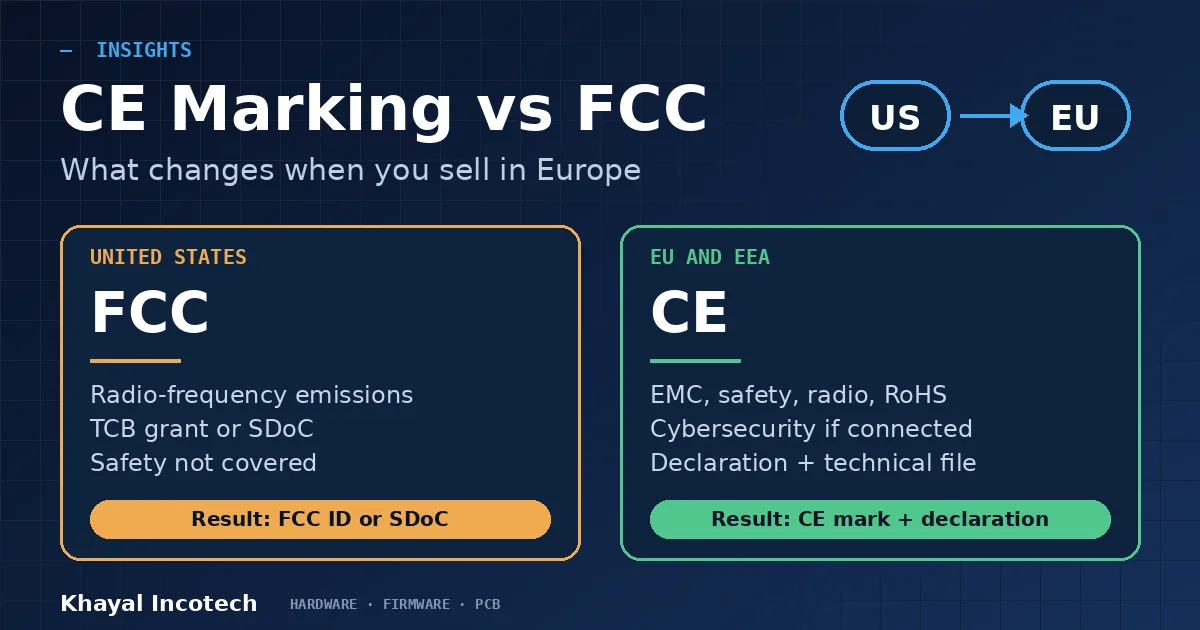
CE marking vs FCC is one of the first questions founders ask once a product works and they want to sell abroad. Both show that your product meets the rules of a market, but they work very differently, and passing one does not mean you have passed the other. This guide covers the EU and EEA. Our guide to FCC certification vs SDoC covers the US side in detail.
The short answer
FCC is the United States. CE marking is the European Union and the wider European Economic Area. A product sold in both needs to meet both sets of rules, and neither market accepts the other’s mark.
The bigger difference is scope. The FCC is mainly concerned with radio-frequency emissions. CE marking is a declaration by the manufacturer that the product meets every EU rule that applies to it, and for electronics that is a longer list.
What each one covers
FCC rules cover the radio-frequency noise your product emits, whether it transmits deliberately or not. Electrical safety is not part of the FCC process.
CE marking covers more ground. The EMC Directive checks both emissions and immunity, meaning how well your product keeps working when exposed to interference. The Low Voltage Directive covers electrical safety for mains-powered products. The Radio Equipment Directive covers any product with a radio. RoHS limits hazardous substances in the materials you use.
Since 1 August 2025, there is one more. Internet-connected radio equipment, which includes many Bluetooth and Wi-Fi products, must meet the cybersecurity requirements of the Radio Equipment Directive. The harmonised standards for this are the EN 18031 series.
Who tests and who signs
In the US, an intentional radiator goes through a Telecommunication Certification Body and receives an FCC ID. An unintentional radiator is covered by a self-declaration, with no ID.
In the EU, there is no equivalent of an FCC ID. For most electronics, the manufacturer tests the product against the relevant standards, puts together a technical file, signs an EU Declaration of Conformity and applies the CE mark. A notified body may be needed in some cases, for example when the harmonised standards are not fully applied.
Self-declared does not mean untested. Market authorities can ask for your technical file at any time, and a declaration is only as good as the test evidence behind it.
What changes if you already passed FCC
Your FCC reports cannot simply be reused. The limits and test methods are different, so a lab will need to repeat the radio and emissions tests to the European standards. Many labs can run both sets in the same visit, which saves time.
New work is also added. Immunity testing is new, because the FCC does not test it. If the product plugs into the wall, there is a safety assessment. You need documentation for RoHS. If it is connected, you need to show how it meets the cybersecurity requirements.
A pre-certified radio module helps, because its test reports go into your technical file. But as with the FCC, the module does not certify the rest of your board. The finished product still needs its own declaration.
Who is responsible in the EU
If you manufacture outside Europe, someone established in the EU must be responsible for your product on the market. That can be an importer, an authorised representative you appoint, or a fulfilment service provider. Their details go on the product or its documents, and they must be able to produce your declaration and technical file for the authorities.
Check this early, because it affects contracts and labels and takes longer to arrange than most founders expect.
Mistakes to avoid
The first mistake is assuming that FCC and CE are interchangeable. They are not, and a product with only an FCC ID cannot be sold in the EU.
The second is skipping the safety work on a mains-powered product. As we explain in our breakdown of what hardware certification actually costs, the safety workstream is often the expensive half.
The third is forgetting the cybersecurity requirements on a connected product, which only became mandatory in August 2025.
The fourth is treating CE marking as a sticker. It is a legal declaration, and the evidence behind it matters.
The fifth is designing for it too late. Problems such as the ones in our guide to buck converter EMC are much cheaper to fix before the board is fabricated.
Plan for both markets from day one
Designing for both markets from the start costs far less than redoing the work later. Our BLE Mesh sensor node, for example, passed FCC and CE on the first submission, because the layout and test plan were built around both from the beginning.
If you plan to sell in the US and Europe, talk to us about production and certification before the design is frozen. Not sure what your product needs? Tell us what it does and we will tell you which rules apply.