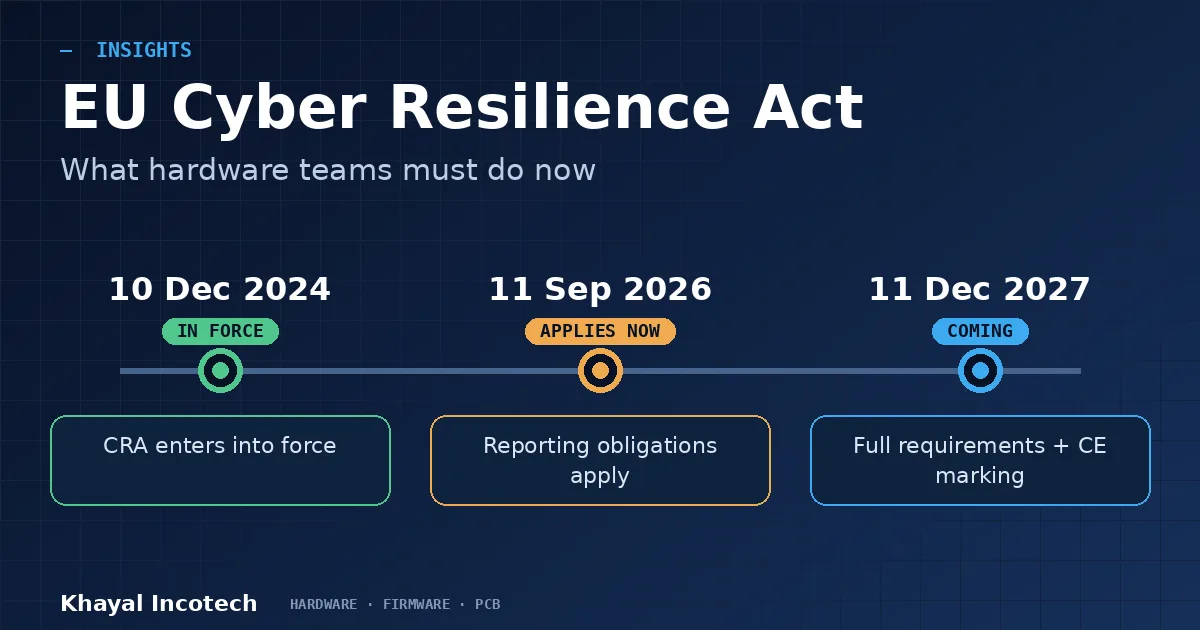
The Cyber Resilience Act for hardware is already partly in force. If you sell a connected product in the EU, part of this law has applied since 11 September 2026, and the rest arrives on 11 December 2027. This guide explains what each date means for a hardware team, and what to do now. It is general information and not legal advice.
What the Cyber Resilience Act is
The Cyber Resilience Act, or CRA, is an EU regulation that sets minimum cybersecurity requirements for connected hardware and software products sold in the EU. It entered into force on 10 December 2024, and its obligations are being phased in.
The dates that matter
10 December 2024: the regulation entered into force.
11 September 2026: the reporting obligations apply. This date has already passed.
11 December 2027: the main obligations apply. From then on, products in scope can only be sold in the EU if they comply with the CRA and carry the CE marking.
What you must report now
Since 11 September 2026, manufacturers must report two things: actively exploited vulnerabilities in their products, and severe incidents that affect product security. The obligation applies to products already on the EU market, including ones placed there before the main rules start.
The reporting clock is short. Sources describe an early warning within 24 hours and a fuller notification within 72 hours of becoming aware. That means a small team needs a named owner, a way for researchers and customers to contact you, and a process that works at night and on weekends.
What changes in December 2027
The main obligations cover the whole life of the product. You will need to assess the cybersecurity risks, design the product to meet the essential requirements, handle vulnerabilities and provide security updates throughout the support period, which must be free of charge.
You will also need an overview of the software components in your product, clear responsibilities, a plan for updates over the product’s life, and the documentation to show it all, because the CE marking will depend on it.
Products placed on the market before December 2027 are generally exempt from the design rules unless they are substantially modified, but the reporting obligations still apply to them.
Who is exempt
Products without digital elements are outside the scope. So are products covered by certain sector rules, such as medical and automotive products, and some open-source software without a commercial purpose. Check where your product falls before you assume either way.
What hardware teams should do now
Name an owner for vulnerability reports, and write down who receives them, who decides, and how you notify the authorities.
List the software in your product, including libraries, SDKs and the operating system, so you know what you would need to patch.
Make sure you can update your devices. That means signed images, a bootloader that can roll back, and a staged rollout, as we explain in our guide to OTA firmware updates. A product you cannot update is a product you cannot fix.
Decide your support period and how you will deliver updates during it.
Plan the certification route. The CRA ties into CE marking, so read our guide to CE marking vs FCC and talk to your lab early.
How it connects to radio rules
Radio products already face cybersecurity requirements under the Radio Equipment Directive, which became mandatory for connected radio equipment on 1 August 2025. The CRA adds broader, lifecycle-wide duties. How the two fit together depends on your product, so confirm it with your certification partner before you plan the design.
Plan security in from the start
Security is far cheaper when it is part of the design than when it is added at the end. We build secure boot and A/B over-the-air updates into our firmware, and we support CE and RED certification, so the update path and the paperwork are planned together. If you sell a connected product in the EU, talk to us about firmware development and certification before the design is frozen. Not sure what applies to you? Tell us what it does and we will tell you what we would check first.