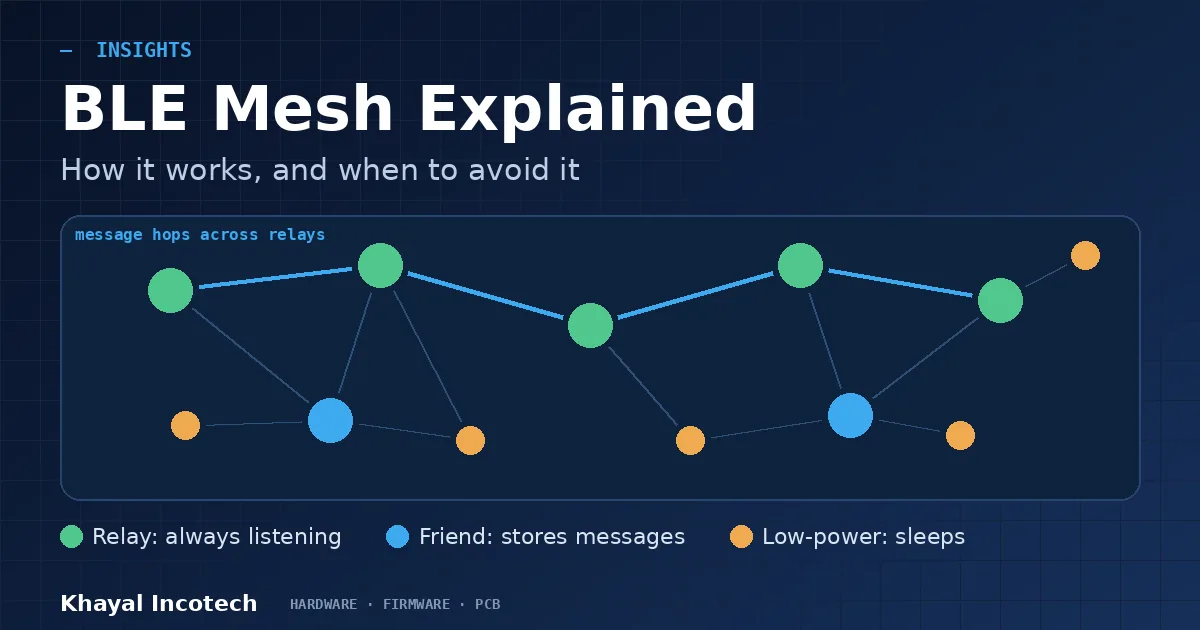
BLE Mesh explained in plain terms: it lets many small Bluetooth devices pass messages to each other, so a network can cover a building that no single radio could reach. It is popular for lighting, building automation and sensor networks, and it is easy to choose for the wrong reasons. This guide covers how it works, what it costs you, and when to pick something else.
What BLE Mesh is
BLE Mesh is a many-to-many network built on Bluetooth Low Energy. It has its own specification and is not part of the core Bluetooth standard. A device that joins the network is called a node, and any node can talk to any other, with no central hub required.
A device joins through provisioning, a step where it receives the security keys it needs. This is usually done from a phone or a gateway.
How messages travel: managed flooding
Most networks send data along fixed routes. BLE Mesh does not. It uses managed flooding, which means a node broadcasts a message and the nodes in range that are set up as relays rebroadcast it, so it spreads across the building.
Two things keep this under control. Each message carries a time-to-live value that drops by one at every hop, and the message dies when it reaches zero. Nodes also ignore messages they have already seen. Because every relay in range rebroadcasts, losing one node does not break the network, since the message finds another path.
The four node roles
A relay node rebroadcasts messages. To do this its radio has to stay on all the time, so relays belong on mains power or a large battery.
A low-power node keeps its radio off most of the time to save battery, and wakes briefly to check in. A friend node stores messages for a low-power node while it sleeps and hands them over when it wakes.
A proxy node lets a phone take part. Phones cannot act as relays, so they connect to the mesh through a proxy using ordinary Bluetooth.
Messaging: publish and subscribe
Nodes communicate by publishing to an address, and other nodes subscribe to that address. For example, a light switch publishes to a group address, and every light in the room subscribes to it.
Using group addresses means you can add or remove devices without reconfiguring the rest of the network, and no central broker is needed.
What BLE Mesh costs you
Battery. Relays cannot sleep, so a network made only of battery devices has a problem. Only low-power nodes can run for a long time on a small cell, and they need a friend node within range. Which nodes act as relays, low-power nodes or friends is a configuration choice, and planning it carefully helps battery nodes last much longer. Our guide to ESP32 vs nRF52 battery life explains why the chip and sleep current matter so much here.
Bandwidth. Flooding creates traffic, because every relay repeats every message. Mesh is built for small commands and readings, not for streaming or large transfers. Making every node a relay can crowd the network, so plan which nodes should relay and set the time-to-live no higher than you need.
Complexity. Provisioning, key management and a commissioning app all need design work before the first device ships. Updating nodes in the field also needs a plan, which we cover in our guide to OTA firmware updates.
When to use it, and when to avoid it
BLE Mesh is a good fit when you have many devices inside a building, each within a few hops of the others, sending small messages, with some mains-powered nodes that can act as relays. It also suits products that people set up from a phone.
Avoid it when the devices are spread over long distances or outdoors, where LoRa is the better tool, as we explain in our guide to BLE vs LoRa. Avoid it when you need high data rates. Avoid it when you only have a few devices near a phone, because plain BLE is simpler. And avoid it when every node must be battery-powered and every node would need to relay.
A real example from our work
Our BLE Mesh sensor node was built for a steel-shelved warehouse, a difficult place for radio, with a requirement for very low sleep current. Off-the-shelf modules would not fit the certification budget, so we designed a custom nRF52840 module with an optimised antenna matching network and a low-leakage DC/DC converter, and wrote the mesh model from scratch in Zephyr.
It shipped 5,000 units, with a 24-month battery life on a single CR2477 coin cell confirmed at the six-month checkpoint, and it passed FCC and CE on the first submission.
Design the network before the hardware
The radio environment, the node roles and the battery budget all shape the board, the firmware and the certification plan. If you are considering BLE Mesh, talk to us about firmware development before the hardware is frozen. Not sure whether mesh is the right choice? Tell us what it does and we will tell you what we would pick.