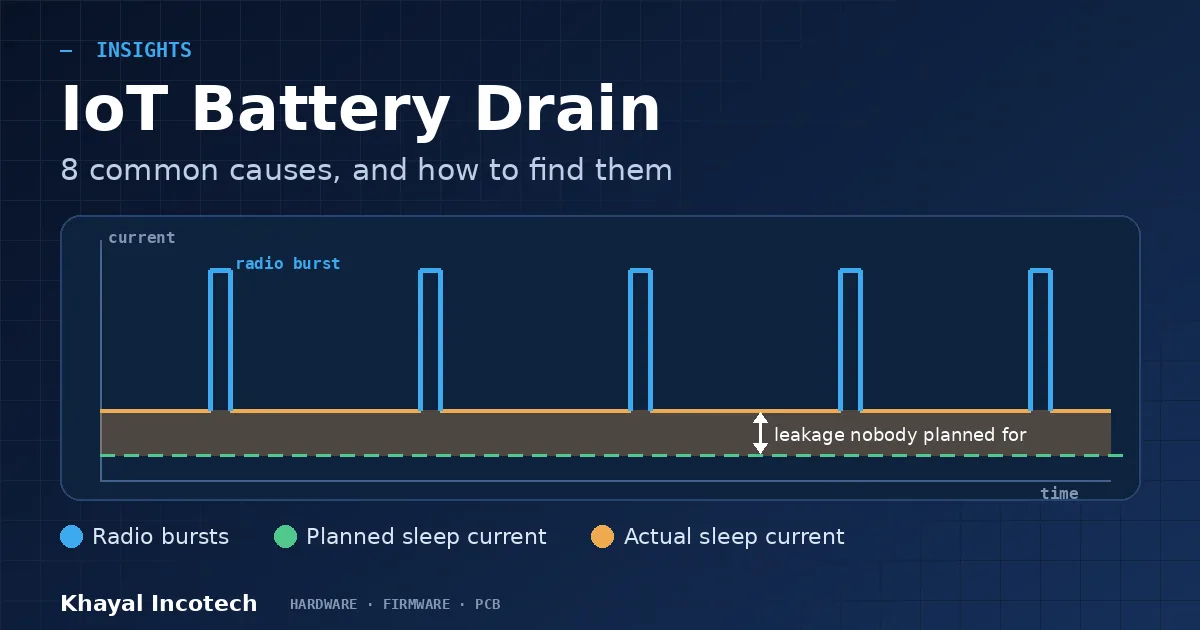
IoT battery drain is the most common reason a connected product misses its battery life target. The datasheet promises years, the prototype lasts weeks, and the radio is usually not the reason. Most of the time the cause is a small, constant current that nobody planned for. Here are eight common causes, and how to find them.
Why average current is what matters
Battery life is the battery’s capacity divided by the average current. A device that sleeps almost all the time is ruled by its sleep current, so a few microamps of leakage can outweigh the radio.
On paper, a 220 mAh coin cell lasts about a year at an average of 25 µA, and about five years at 5 µA. That is why chasing small, constant currents pays off more than optimising the radio.
Eight common causes
The chip never reaches deep sleep. A peripheral, a timer, a debug interface or a pending interrupt keeps it awake. Check which clocks and peripherals are still running when the device should be asleep.
A hungry regulator. A regulator draws its own quiescent current all the time. One that uses tens of microamps by itself can cost more than the chip’s sleep current. Our guide to ESP32 vs nRF52 battery life looks at this in more detail.
Leaky pins. Floating inputs, pull-up and pull-down resistors that fight each other, and pins that drive current into a part that is powered off all leak quietly.
Sensors and modules that never switch off. Sensors, LEDs, GPS receivers and modems should sit behind a load switch and be powered down when idle.
A radio that works too hard. Advertising or connecting more often than you need, staying connected when you could disconnect, or rejoining Wi-Fi on every wake-up all cost energy. Our guides to BLE vs LoRa and BLE Mesh explain how different radio choices change this.
Retries and long wake-ups. A device that keeps retrying a failed connection can use more energy than ten successful transmissions. Cap the retries and back off between attempts.
A battery that cannot deliver. Cold, ageing and small cells have a high internal resistance, so a radio burst pulls the voltage down. The chip can then brown out and restart, and a restart loop drains the battery fast.
Dev-board leftovers. Development boards carry a USB-to-serial chip, a power LED and extra regulators that draw milliamps. Battery life measured on a dev board says little about the finished product.
How to measure it
An ordinary multimeter averages badly and misses short pulses, so it can hide exactly the problem you are looking for. We use Nordic's Power Profiler Kit II with its Power Profiler app to record current over time. A shunt resistor with an oscilloscope also works.
Measure three things: the sleep current, the burst current and how long it lasts, and how often the device wakes. Then work out the average, as we did in the worked example in our guide to ESP32 vs nRF52 battery life. Whenever you can, measure with the real battery and at the temperatures the product will see.
Examples from our own work
On our SwellFrame always-on e-paper display, standby current decides the whole product. The panel sits behind a load switch that cuts its supply entirely between refreshes, and the switch leaks only ten nanoamps when off. You can see it on our Work page.
Our BLE Mesh sensor node needed very low sleep current for a warehouse deployment. A custom board with a low-leakage DC/DC converter and sleep-focused firmware delivered a 24-month battery life on a single coin cell, confirmed at the six-month checkpoint.
Write the power budget before the layout
A power budget lists every state the device can be in, the current it draws there, and how long it stays there. Writing it before layout tells you which chip, which regulator and which switches the design needs. Finding a 20 µA leak after the boards are built costs far more than finding it on paper.
If you are designing a battery-powered product, talk to us about PCB design and firmware development early. Not sure whether your target is realistic? Tell us what it does and we will tell you what we would check first.