UL vs ETL is a question that comes up as soon as a product plugs into the wall, because a retailer, an inspector or an insurer asks for a safety mark. Both marks are respected, and for most products the difference is smaller than people expect. This guide explains what each one means, where they really differ, and how to choose.
The short answer
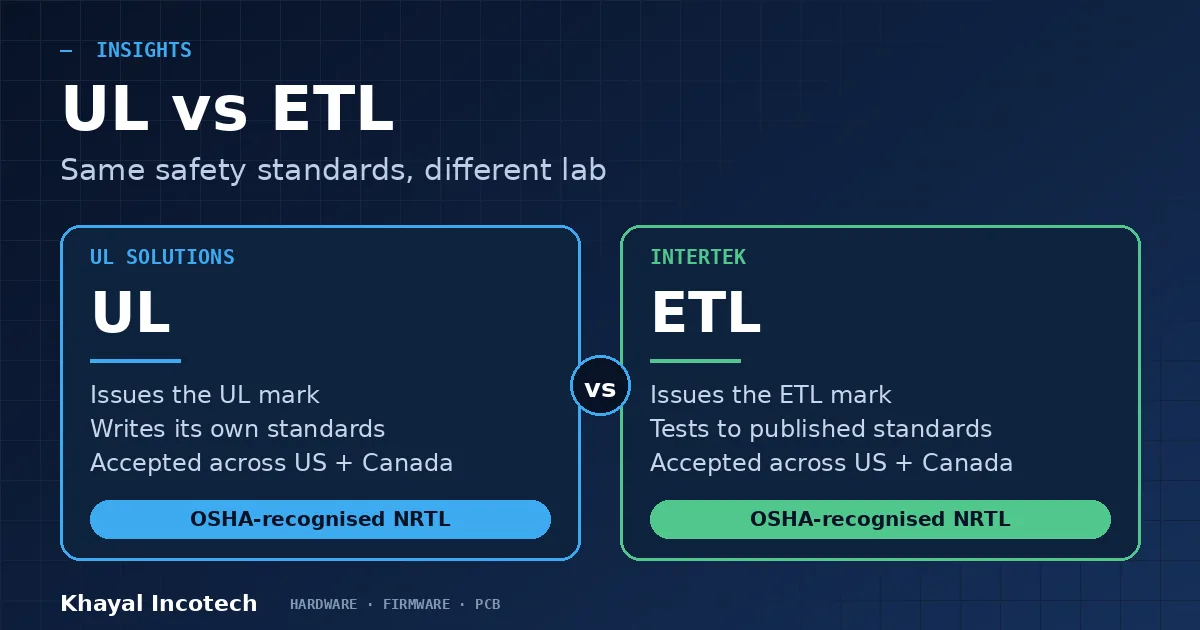
Both UL and ETL are safety marks issued by labs that OSHA recognises as Nationally Recognized Testing Laboratories, or NRTLs. For most products, the difference is which lab tests it, how quickly and at what price, and not how safe the product has to be.
What matters most is whether the people who will check your product accept the mark.
What UL and ETL are
UL Solutions issues the UL mark, and Intertek issues the ETL mark. UL writes many of its own safety standards. Intertek tests to standards written by others, including UL’s.
A product listed by either lab has been tested to the applicable standard, and the listing usually includes follow-up inspections at the factory.
What the lab actually tests
For a mains-powered product with a heater and motors, the lab checks temperature rise and abnormal operation, which means deliberately faulting the product to confirm it does not start a fire. It also tests dielectric strength and leakage current.
It carries out a construction review too, checking that every safety-critical component is itself a recognised part. We cover what this does to a budget in our breakdown of what hardware certification actually costs. A battery-powered device with no mains connection avoids most of it.
Where the real differences are
Acceptance. OSHA does not prefer one recognised lab over another for the same standard, and ETL is widely accepted across the US and Canada. Some inspectors and buyers still ask for UL out of habit, so do not assume either mark is accepted everywhere. Ask the people who matter.
Scope. A lab must be recognised for the specific standard your product falls under. Check the lab’s scope before you commit.
Time and price. Several sources say ETL is often faster and cheaper, but they come from interested parties. Ask both labs for a quote and compare.
Canada. Canada requires a mark from an accredited certification body. The combined cETLus mark covers both the US and Canada.
What neither mark covers
A UL or ETL mark does not replace CE marking, which is a separate route for Europe, as we explain in our guide to CE marking vs FCC.
It also does not cover the radio. A mains-powered product with a wireless module needs a safety mark for the safety side and an FCC route for the emissions, as we cover in our guide to FCC certification vs SDoC.
Mistakes to avoid
The first mistake is using safety-critical parts without approvals. A cheap thermal cutout bought from a marketplace may fail the construction review, and you end up respinning the design after the report comes back.
The second is starting after the layout. Spacing, component choices and the enclosure are fixed by then, so plan the safety work from the first placement.
The third is assuming one mark suits every buyer. Check what each retailer or distributor accepts before you choose.
The fourth is forgetting the factory. Listing includes follow-up inspections, so your production site needs to be ready for them.
Which should you choose?
Ask first. Ask your retailer, distributor or inspector which marks they accept. If both are accepted, get quotes from both labs and compare the price, the schedule and how well each lab knows your type of product. If someone specifically requires UL, use UL.
An example from our own work
Our Foodease smart cooker is a mains-powered appliance with a heater and motors. We designed it for CE and ETL from the first component placement, and it passed both on the first submission. You can read the case on our Work page.
Plan safety before the layout
Safety certification is cheapest when it is designed in from the start. If your product plugs into the wall, talk to us about production and certification before the layout is frozen. Not sure which mark you need? Tell us what it does and we will tell you what we would check first.