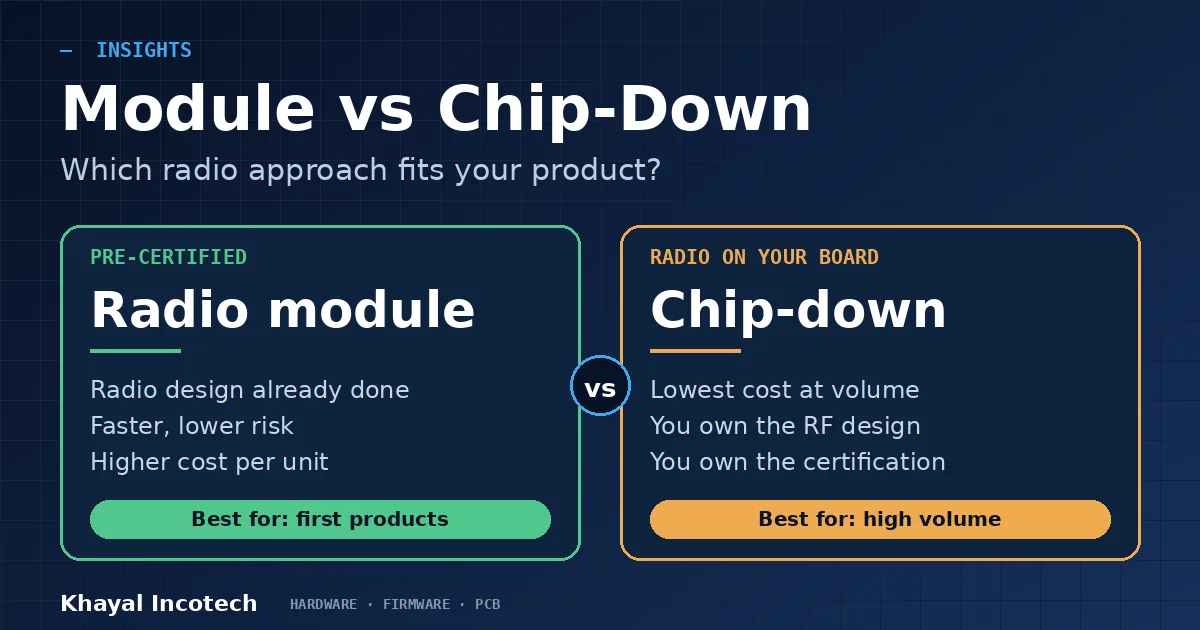
Module vs chip down is one of the first big decisions in any wireless product, and it is easy to get wrong in either direction. A pre-certified radio module is quick and low-risk, but it costs more per unit. A chip-down design puts the radio chip straight onto your board and can be cheaper at volume, but you take on the RF design and the certification yourself. Here is how to choose.
What each option means
A radio module is a small board that already carries the chip, the crystal, the matching network, the antenna and a shield. You solder it onto your board like any other component.
A chip-down design skips the module. You place the radio chip on your own board and design the matching network and the antenna yourself.
Why a module is the usual choice for a first product
The radio is designed and tested by people who do it for a living, and in the US the module usually carries its own FCC approval. Your product does not repeat the intentional-radiator work, which saves time, money and RF risk.
It also leaves room to improve later. Choose a module built on the same chip family you might use chip-down, and your firmware stays portable if you move to a custom design in version two.
What a module does not do for you
A pre-certified module reduces your certification burden, but not necessarily your testing burden. It was approved on its own, with its own antenna and no other electronics nearby. Your product is none of those things, and your enclosure, antenna placement and board layout can all change how the radio performs.
The approval also comes with conditions, such as approved antenna types, keep-out areas and host requirements. If your design breaks them, the modular approval no longer covers you. We explain this in our guide to FCC certification vs SDoC.
The rest of your board still has to pass on its own, which is where problems like those in our guide to buck converter EMC come in. In Europe, the module’s test reports go into your technical file, but the finished product still needs its own declaration, as we explain in our guide to CE marking vs FCC.
Finally, you depend on the module maker for supply and pricing.
When chip-down makes sense
Chip-down is worth considering when your volume is high enough for the per-unit saving to add up, when size or antenna constraints rule out a standard module, or when your team has real RF experience and equipment.
Estimates of the break-even volume vary widely, from tens of thousands of units to well over 200,000, depending on the product and the markets. Treat any single figure with caution, and work it out for your own case.
The hidden costs of chip-down
You pay for the RF design, the antenna design and tuning, and the pre-compliance testing. You also own the full intentional-radiator certification in every market you sell in.
The risk is real too. A failed chamber visit means another test fee and a board respin, as we show in our breakdown of what hardware certification actually costs. A module moves most of that risk to the vendor.
How to decide
If this is your first product, your volume is modest or your schedule is tight, use a module.
If you expect very high volume, have hard size or cost limits, and have RF experience on the team, plan for chip-down.
If you are not sure, start with a module and design the board so a chip-down version is possible later. You will learn what the product really needs before you commit to the RF work.
We have shipped both
Our SwellFrame always-on display uses an ESP32 module. The module's own approval covers only the module, so the finished product went through certification as a whole. SwellFrame passed product-level certification and carries its own FCC and CE marking, tested both on battery and while charging from a wall adapter. You can see it on our Work page.
Our BLE Mesh sensor node took the other route. Off-the-shelf modules would not fit the certification budget, so we designed a custom nRF52840 module with an optimised antenna matching network. It shipped 5,000 units and passed FCC and CE on the first submission.
Decide before the schematic
The radio approach shapes the board, the antenna, the firmware, the certification plan and the unit cost, so it is much cheaper to decide before the schematic than after. If you are choosing between a module and chip-down, talk to us about PCB design before you commit. Not sure which one fits your volume? Tell us what it does and we will tell you which route we would take.