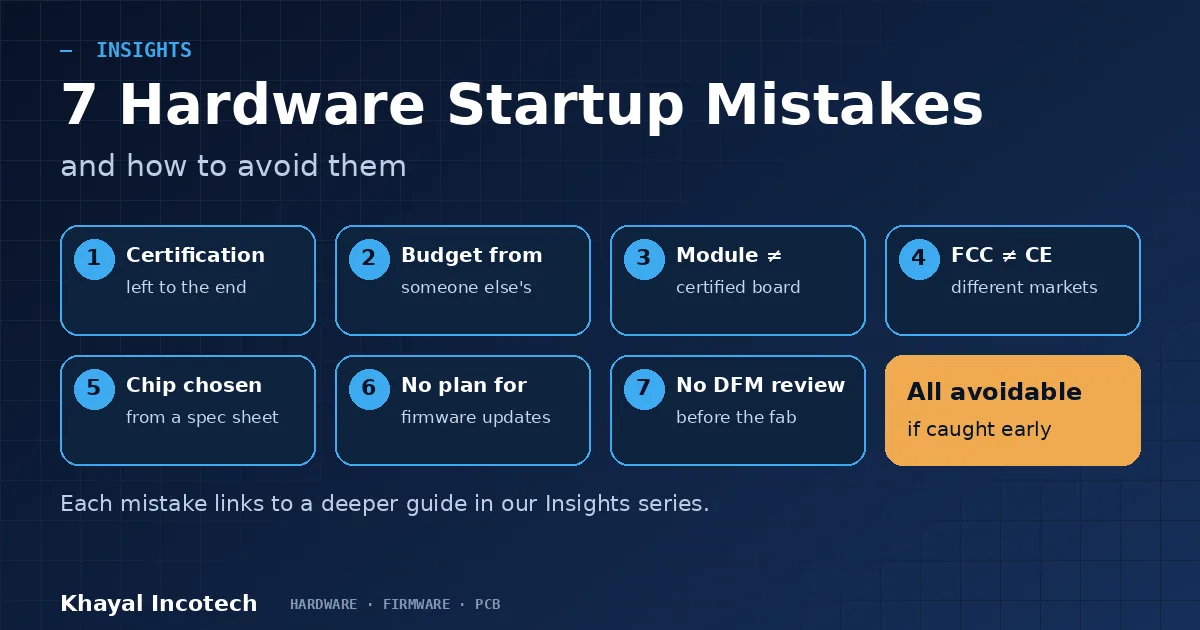
Hardware startup mistakes are expensive for one reason: you cannot patch a board the way you patch an app. A mistake made in the schematic shows up months later as a failed test, a missed battery target or a respin. After shipping more than 25 hardware products, we see the same seven mistakes again and again. Each one below links to a deeper guide.
1.Treating certification as the last step
By the time a board is fabricated, most of what decides a pass or a fail is already fixed: where the switching node sits, whether the ground plane is whole, and how the cables enter the enclosure. A failed lab visit then costs you the test fee again, a respin, and the lead time on both.
The fix is to design for certification from the first layout and to pre-scan on the bench before the lab. Our guide to buck converter EMC shows the layout mistakes behind most failures.
2. Budgeting from someone else’s number
“Certification cost us three thousand dollars” means little unless you know what was in the product. A battery-powered device with no mains connection avoids many tests. A product with a heater and motors on the mains needs safety work, and its bill can be several times larger.
List what is inside your product before you budget. Our breakdown of what hardware certification actually costs shows real numbers from two of our own products.
3. Assuming a pre-certified module certifies your board
A module with an FCC ID covers the radio. Your converters, microcontroller and charging circuit inherit nothing from it. The approval also comes with conditions on the antenna and the layout, and breaking them can put you back in full certification.
Read the grant conditions before you lay out the board. Our guide to FCC certification vs SDoC explains the two routes, and our guide to module vs chip down helps you choose between a module and a custom radio.
4. Assuming FCC covers Europe
FCC and CE are different systems. The FCC is mainly about radio-frequency emissions in the US. CE marking is a declaration that the product meets every EU rule that applies, which can include immunity testing, electrical safety, radio rules and, for connected products, cybersecurity requirements.
Plan for both markets from the start. We cover the differences in our guide to CE marking vs FCC.
5. Choosing the radio and the chip from a spec sheet
The wireless technology and the chip shape the whole product. Bluetooth, LoRa and Wi-Fi suit very different jobs, and a chip’s sleep current alone can mislead you about battery life. Many products miss their battery target because of small constant currents, not because of the radio.
Write a power budget before the layout. Our guides to BLE vs LoRa, ESP32 vs nRF52 battery life and IoT battery drain show how to do it.
6. Having no plan for updates
A product you cannot update is a product you cannot fix. Over-the-air updates need flash space for two firmware images, a bootloader that can roll back, signed images and a staged rollout. These decisions are hard to change once the flash map is fixed.
Decide the update path early. Our guide to OTA firmware updates explains how they work and what breaks them.
7. Skipping the manufacturing review
Wrong footprints, mask problems, missing test points and parts that are out of stock all delay a build, and most are easy to catch before the files go to the fab. Run a design-for-manufacturing check, and ask someone who did not design the board to review it.
Our PCB DFM checklist covers ten checks to run before you send your Gerbers.
How to avoid all seven
None of these mistakes is hard to avoid if you catch it early, and all of them are expensive if you catch them late. A single review before the schematic is frozen, covering certification, radio choice, battery life, updates and manufacturing, prevents most of them.
If you are building a hardware product, book a short consultation with us. We can also help with PCB design and the production run. Not sure where your product stands? Tell us what it does and we will tell you what we would check first.